Recruiting the right employees is one of the most important responsibilities for a small business owner. The people you hire can influence your company’s productivity, culture, customer service, and long-term growth. However, small businesses often have limited budgets, fewer resources, and less time than large organizations.
A clear recruiting process can help you attract qualified candidates, make better hiring decisions, and avoid costly mistakes. Use this step-by-step guide as a resource to create the perfect recruiting process for your business.
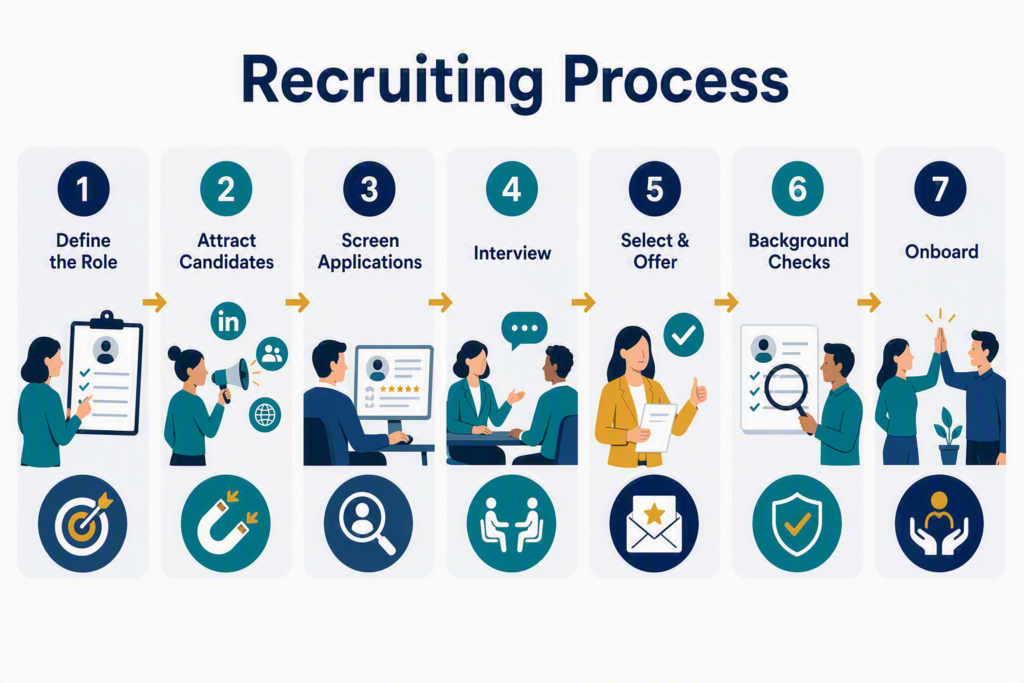
Step 1: Identify Your Hiring Needs
Before advertising a position, define why you are hiring and what the business needs from the new employee. Ask yourself:
- Is this a new role or a replacement position?
- What responsibilities will the employee handle?
- Is the position full-time, part-time, temporary, or contract-based?
- What skills are essential?
- What salary and benefits can the business afford?
- How will success be measured?
Creating a clear role description at this stage helps ensure that everyone involved understands the purpose of the position.
Step 2: Write a Clear Job Description
(Refer to the Resource on “How to Write a Job Description”)
Step 3: Choose the Right Recruitment Channels
Small business owners do not need to advertise everywhere. Focus on channels that are likely to reach the right candidates. Useful options include:
- Local job boards
- Professional networking sites
- Industry-specific websites
- Social media
- Community groups
- Local colleges or training centers
- Employee referrals
- Your company website
- Professional associations
Employee referrals can be especially valuable because current employees may recommend people they know and trust. Consider an incentive program for current employees who refer a successful candidate (i.e. an employee referred a person to you to consider as a candidate for hire. The referred candidate was hired and employed for a minimum of (3)(6)(9) months). However, referral programs should not be the only source of candidates, since relying exclusively on personal networks can limit diversity.
Step 4: Promote Your Employer Brand
Your employer brand is the impression candidates have of your business as a workplace. Even a small company can build a strong employer brand by explaining what makes it a good place to work. Sell your business!!! Highlight:
- Company values
- Leadership style
- Workplace culture
- Training opportunities
- Flexible work arrangements
- Community involvement
- Opportunities for advancement
- Meaningful projects
Be honest. Promising a workplace culture or level of flexibility that does not exist can result in disappointed employees and high turnover. Transparency and honesty are key!
Step 5: Review Applications Efficiently
When applications arrive, use consistent criteria to assess them. Focus on the skills and experience that are genuinely relevant to the role. You may create a simple screening checklist based on:
- Required qualifications
- Relevant experience
- Technical skills
- Communication ability
- Availability
- Work authorization, where applicable
- Alignment with the role’s responsibilities
Avoid making decisions based only on a candidate’s name, age, gender, appearance, personal background, or other characteristics unrelated to job performance. A structured process helps reduce unconscious bias. Trust me when I say I learned from experience in this area, use the structured process you create for recruiting!
Step 6: Conduct Effective Interviews
Interviews should be prepared and consistent. Ask each candidate a similar set of core questions so that you can compare responses fairly. Useful questions include:
- Can you tell us about your experience with this type of work?
- Describe a challenge you faced in a previous role and how you handled it.
- How do you prioritize competing tasks?
- What interests you about working for a small business?
- What type of work environment helps you perform your best?
- What questions do you have about the role?
Behavioral questions are useful because they encourage candidates to describe real examples rather than provide general claims. Avoid “yes” and “no” questions for the candidate. Use questions that require detailed responses. For some roles, consider adding:
- A skills test
- A writing sample
- A practical assignment
- A portfolio review
- A second interview with team members
Step 7: Check References Carefully
Reference checks can help confirm a candidate’s employment history, responsibilities, and work habits. Ask the candidate for permission before contacting references and use consistent questions for each applicant. You might ask:
- What was the person’s role and period of employment?
- What were their main responsibilities?
- What were their strongest skills?
- How did they respond to feedback?
- Would you rehire them?
Follow applicable privacy and employment laws when collecting and using reference information. Checking references may be difficult at times. Past employers are sometimes hesitant to share information regarding a prior employee.
Step 8: Make a Fair and Competitive Offer
Once you have selected a candidate, provide a written offer that clearly explains the terms of employment. The offer should typically include:
- Job title
- Start date
- Compensation
- Pay frequency
- Working hours
- Benefits
- Reporting manager
- Probationary or introductory period, if applicable
- Conditions of employment
- Any required documentation
Research typical compensation for similar positions in your area and industry. If you cannot offer the highest salary, consider emphasizing other forms of value, such as flexible scheduling, additional leave, training, or performance incentives.
Be sure to “disposition” (say “no, thank you”) to candidates who were not selected, especially those who interviewed or met with anyone on your team.
Step 9: Prepare for Onboarding
Recruiting does not end when a candidate accepts the offer. A well-planned onboarding process helps new employees become productive and feel welcome. Before their first day:
- Prepare their workspace and equipment
- Create email and system access
- Share the schedule
- Prepare required paperwork
- Inform the team
- Plan initial training
During the first few weeks, be prepared to explain:
- Company policies
- Job expectations
- Key responsibilities
- Communication procedures
- Performance goals
- Who the employee should contact for help
A positive onboarding experience can improve retention and reduce the time it takes for a new employee to work independently. I have found that onboarding can make or break a new employee, a great onboarding is the beginning at developing a successful working relationship for the new employee.
Step 10: Evaluate and Improve the Process
After completing a recruitment campaign, review what worked and what did not. Consider:
- How many applications did you receive?
- Which recruitment channels produced the best candidates?
- How long did the process take?
- Did candidates receive timely communication?
- Did the successful hire meet expectations?
- Were there any repeated problems or delays?
Tracking these results helps you improve future hiring decisions. Over time, your business can develop a repeatable process instead of starting from scratch each time a position becomes available.
Common Recruiting Mistakes to Avoid
Small business owners often make a few predictable hiring mistakes:
- Hiring too quickly. A vacant role can create pressure, but rushing may lead to a poor fit. Take enough time to evaluate candidates properly.
- Being unclear about expectations
- Candidates should understand the responsibilities, schedule, compensation, and working conditions before accepting the position.
- Focusing only on experience. Experience is important, but attitude, adaptability, reliability, and willingness to learn may be equally valuable.
- Ignoring cultural fit. Skills can sometimes be developed, but a candidate whose behavior conflicts with the company’s values may create long-term problems.
- Failing to communicate. Keep applicants informed throughout the process. Even candidates who are not selected may become customers, referrals, or future applicants.
- Neglecting legal requirements. Hiring practices must comply with applicable employment, discrimination, wage, privacy, and recordkeeping laws.
Final Thoughts
A successful recruiting process does not have to be complicated or expensive. Small business owners can improve their hiring results by defining the role clearly, advertising strategically, using structured interviews, communicating professionally, and investing in onboarding.
The goal is not simply to fill a vacancy. It is to find someone whose skills, values, and potential support the long-term success of the business.
Grab the Template
Use this guide along with the Recruiting Process Worksheet so you and your hiring team can create the process that is right for your company to recruit good employees.
Campfire Tip 🔥
An employer’s feelings after a good interview should be a blend of confidence, enthusiasm, rapport, clarity, and professional satisfaction. These emotions are the natural result of a candidate who demonstrates competence, cultural fit, and potential, and they guide the employer toward making a positive hiring decision
This resource is brought to you by Campfire Guide Jill! A bit about Jill: “My name is Jill and I have spent 32 years as an HR professional working with multi states, early career I spent many years in the manufacturing industry and the latter years in retail independent pharmacy. My career has covered all aspects of the HR world, spanning from developing an HR department from the ground up to having a well-developed team within an organization. Personal info includes I was born and raised in Missouri, moved to Colorado four years ago to be close to be two grandchildren.”